Council of Heads of Australasian Herbaria
Australian National Herbarium
Biographical Notes

|
|
Council of Heads of Australasian Herbaria | |
 Cooper, Harold More (1886 - 1970)
He was born on 29 December 1886 in North Adelaide, SA; he died on 14 May 1970 at Glenelg,SA.
He was the eldest son of Robert Cooper, accountant, and his wife Mary Antill, née Osborne.
He was educated locally at Queen's School and through travel in Europe.
From the age of 18 Harold was employed by the Eastern Extension Australasian & China Telegraph Co. Ltd, Adelaide; he resigned in 1926 after spending years of exhausting shiftwork transmitting and receiving morse code.
From his Glenelg home he operated an amateur, experimental wireless station. He participated in research, including the effects of climatic conditions and sunspot disturbances on long-distance, short-wave communication.
From 1934 Cooper studied local Aboriginal historic sites with a special focus on sites at Hallett Cove and Kangaroo Island.
In 1941 he was appointed assistant-ethnologist at the South Australian Museum. He was recognised by Norman Tindale, then curator of anthropology at the museum, for his work ensuring that the indigenous tools and artefacts were recognised as "the handiwork of the first Australians".
In addition to archaelogical items, Cooper brought back numerous specimens, among them new species of land snails and insects.
His recreations were sailing and deep-sea fishing, and he secured many rare fishes, including two new species.
In 1957 he resigned from his position at the museum but continued as honorary associate in anthropology until 1968.
He died, unmarried, on 14 May 1970 at Glenelg, and was buried in St Jude's Anglican churchyard, Brighton.
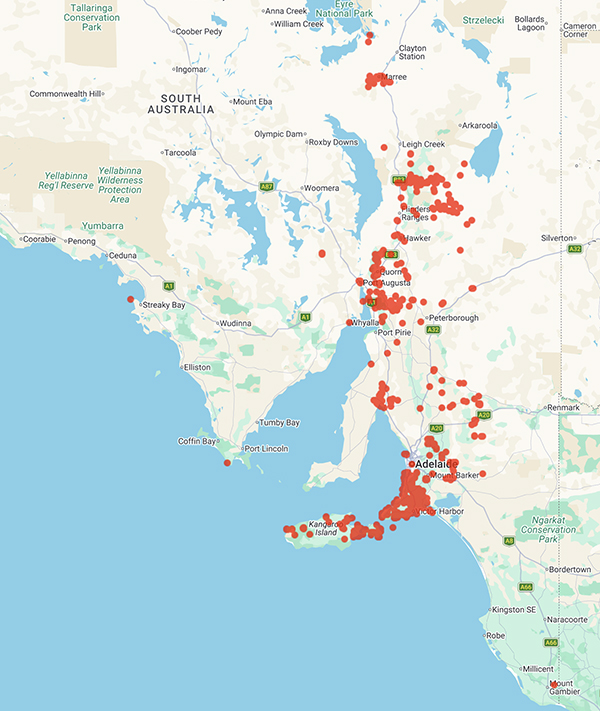
Most of his plant specimens are at the South Australian Herbarium (AD) with collecting dates from 1920 to 1969.
Source: Extracted from:
https://adb.anu.edu.au/biography/cooper-harold-more-9821
https://en.wikipedia.org/wiki/Harold_More_Cooper
Portrait Photo: none known, can you help?.
Data from 3,671 specimens