
Council of Heads of Australasian Herbaria
Australian National Herbarium
Biographical Notes

|
|
Council of Heads of Australasian Herbaria | |
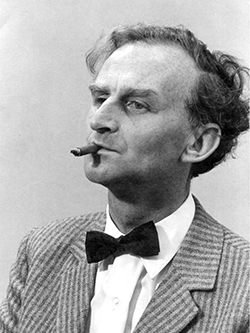 Hartog, Kees (Cornelis) den (1931 - 2021)
Born on 28 January 1931 in Den Helder (in NW of the Netherlands); died in 2021, date not found.
His interest in botany started during the World War II period when, as a 13-year-old boy, he was forced to stay at home in the rural village of Broek op Langedijk because of allied air raids on the trains which used to transport him to his school in the naval town of Den Helder.
To pass the time, Kees started to identify plants in the surroundings of this rural village, using a concise school flora.
After the war, the family den Hartog returned to Den Helder where his father became a bank manager.
Kees became a member of the 'Netherlands Youth Federation for the Study of Nature' (N.J.N.). You could become a member at 12 years old and had to leave at an age of 23 years.
In 1949, Kees started studying biology at the University of Amsterdam, where the topics he studied were systematics and geography of plants, plant physiology, tropical botany, zoogeography, and ecology.
Prof. Dr. C. van Steenis, one of his teachers, asked him to revise the aquatic plant family Hydrocharitaceae for the Flora Malesiana, and thus Kees became acquainted with tropical fresh water plants and seagrasses.
In 1956, Kees took his MSc. degree but further research was temporarily interrupted by the military service from 1956-1958.
As there was no available post for a phycologist, Kees became employed as a zoologist at the 'Delta Institute for Hydrobiological Research' (DIHO) in Yerseke from 1958-1963.
During his time at DIHO, Kees was also able to complete his thesis entitled 'The epilithic algal communities occurring along the coast of the Netherlands', which yielded him his PhD degree, with first-class honors, in 1959 at the University of Amsterdam.
In 1960, Kees met the English biologist Irene May Adams (1932-2011), they married in 1961.
In 1963, Prof. Van Steenis offered him a position at the National Herbarium at Leiden. He continued the study of aquatic angiosperms and algae and the revision of the aquatic plant families for the Flora Malesiana.
His expedition to Australia in 1967 yielded many new specimens of seagrasses and other aquatic macrophytes.
From 1970-1975, Kees was appointed as an extraordinary professor of botany and general ecology at the Flemish Vrije Universiteit Brussel (VUB), Belgium; and in 1973, Kees left the National Herbarium, to fulfill his position as a full professor of aquatic ecology at the University of Nijmegen.
In September 1973, Kees founded the Laboratory of Aquatic Ecology at the University of Nijmegen, dedicated to the study of 'Structure and functioning of aquatic ecosystems dominated by macrophytes'.
From the 1970s onwards he published several papers with specific reference to Australian seagrasses and aquatic plants.
His Australian collections use the initial 'C.' rather than 'K.' for 'Kees'.
Source: Extracted from:
Gerard van der Velde (2022) 'Remembering Kees (Cornelis) den Hartog (1931-2021) - pioneer in aquatic ecology and the founder of aquatic botany', Aquatic Botany Vol.180, Aug 2022
Portrait Photo: https://ars.els-cdn.com/content/image/1-s2.0-S0304377022000432-fx1_lrg.jpg.
Data from 373 specimens
