
Council of Heads of Australasian Herbaria
Australian National Herbarium
Biographical Notes

|
|
Council of Heads of Australasian Herbaria |
|
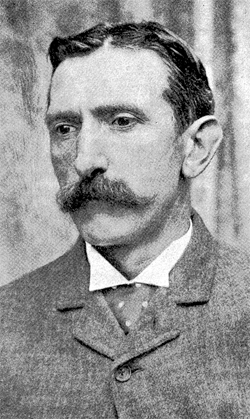 Whitelegge, Thomas (1850 - 1927)
Born on 7 August 1850 at Stockport, Cheshire, UK; died on 4 August 1927 in Royal Prince Alfred Hospital, Sydney, NSW.
English-born museum assistant and bryologist in Australia.
Thomas Whitelegge was born into poverty in Stockport, Cheshire. His father was an illiterate bricklayer and Thomas finished his schooling aged eight to work in a local factory. He was subsequently taken on as an apprentice hatter, but, breaking the terms of his indenture, went into hiding. It was during this time, in which he lived on a farm in Lancashire, that he developed an interest in natural history.
He eventually found more work as a journeyman with a hat manufacturer. In his spare time he began to attend lectures in natural history and to build a fossil collection, before in 1874 joining the Ashton-under-Lyne Linnean Botanical Society. He was in his early twenties when he founded the Ashton Biological Society and began to teach botany in schools. At this time Whitelegge entered into correspondence with Charles Darwin on the subject of plant reproductive strategies.
In 1880 Whitelegge married Ellen Steele and with their young family migrated to Australia.
After arriving in Sydney in 1883 he found work as a plasterer and also in a brewery. He soon met the president of the Linnean Society of New South Wales at that time, the Rev. Julian Tenison-Woods, and became a member of both that society and the Royal Society of New South Wales. Among his new circle of naturalist friends was E.P. Ramsay, curator of the Australian Museum, where Whitelegge was given a temporary position, and in 1887 was appointed senior scientific assistant in charge of the lower vertebrates. He wrote many articles on this topic.
In the same year as his selection for the post at the museum, Whitelegge's wife died in childbirth.
One of Whitelegge's most important works was his 1889 article, "List of the marine invertebrates of Port Jackson and neighbourhood" (published in the Royal Society's Journal and Proceedings).
He also had an interest in ferns and
mosses and in 1884 began to gather information on the mosses of New South Wales
primarily in Sydney, Gosford, Moss Vale and Blue Mountains. At the urgent request
of Dr. V.F. Brotherus in Helsinki, who was preparing the volumes on mosses for
Engler & Prantl's Die Naturlichen Pflanzenfamilien. Whitelegge secured nearly 100 species in 1890-91.
In 1898
Whitelegge met William Watts and they jointly presented a list of some 500 species for
publication by the Linnean Society of New South Wales. Later the manuscript was
withdrawn in favour of a broader list (Census) covering Australia (Census Muscorum Australiensum). This was published in their joint names in 1902 and 1905, and dealt with the acrocarpous mosses
[the pleurocarpous species were published later after their deaths.
Whitelegge's position at the Australian Museum in the early 1900s prevented him
from continuing research on mosses and he handed over this activity to Watts.
He also taught botany at the Sydney Mechanics' School of Arts and at Sydney Technical College.
He resigned from his museum position in 1908 but continued to work at the NSW National Herbarium.
SEE ALSO, 1927 OBITUARY:
https://media.australian.museum/media/Uploads/Journals/17175/764_complete.pdf
Sources: Extracted from:
https://plants.jstor.org/stable/10.5555/al.ap.person.bm000333023
https://media.australian.museum/media/Uploads/Journals/17175/764_complete.pdf
https://www.botanicgardens.org.au/sites/default/files/2023-09/Volume-3%281%29-1993-Ramsay215-229.pdf
Cunninghamia Vol. 3(1): 1993,
'Bryophytes of the Royal Botanic Gardens,
Government House and the Domain, Sydney',
by
H.P. Ramsay, R.G. Coveny, E.A. Brown and A.K. Brooks.
Portrait Photo: Extracted from Obituary above.
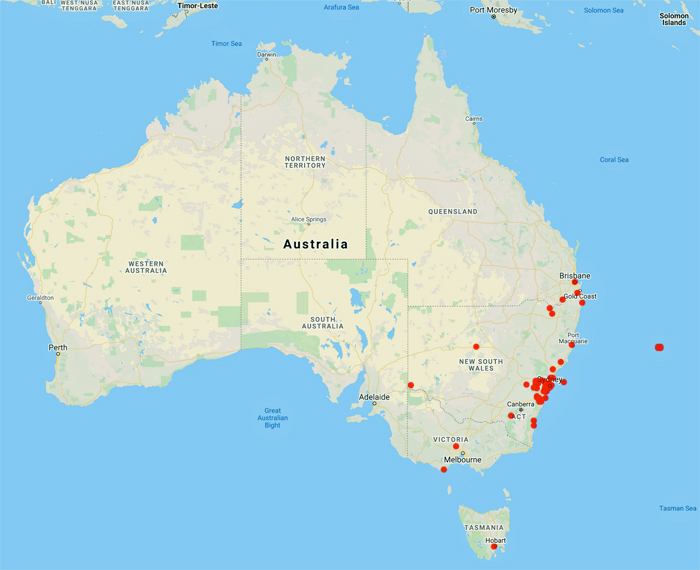
Data from 1,502 specimens